

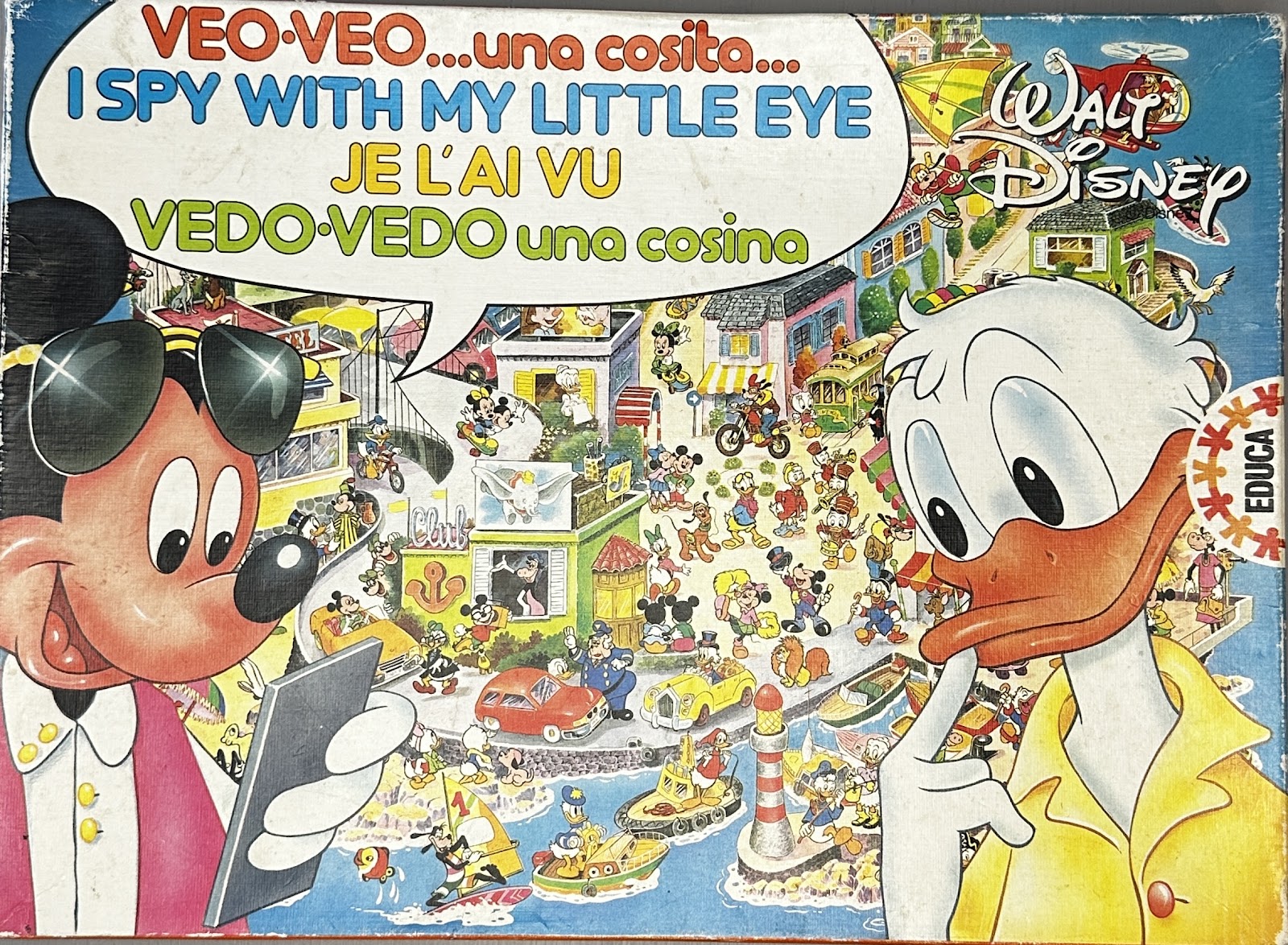
A guessing game with many names
The title printed across this Disney box is itself a small lesson in how children play across borders. “I Spy With My Little Eye” is the English form of an old verbal guessing game in which one player spots an object and gives a clue — traditionally its first letter — while the others try to name it. The same game travels under the Spanish name “Veo Veo” (literally “I see, I see”) and the French “Je l’ai vu” (“I saw it”). Printing all three on one package signals exactly what this product was: a single Disney game manufactured for several European markets at once.
In Spanish-speaking countries “Veo Veo” carries an extra resonance. A children’s song of that name, recorded by the group Teacher & Peter and popularized in the early 1980s, made the phrase a fixture of Spanish childhood. The exact chronology of that song’s release and chart life is the kind of detail worth confirming against a primary source rather than memory, but the phrase’s familiarity to Spanish children of the period is well established — which made it an obvious hook for a localized children’s game.
The game itself
Rather than a verbal back-and-forth, this Educa edition translates the guessing game into a printed seek-and-find: a large, densely populated Disney scene in which players hunt for characters and objects hidden among the crowd. That observation-and-search format was a natural fit for a multilingual release, because the core play — looking, finding, pointing — needs little translation. The box copy describes a cast of classic Disney characters scattered through the artwork, the same approach that would later make printed “search-and-find” books a publishing staple. Beyond the broad strokes — multilingual labeling, a Disney license, an observation premise — the specifics of rules, components, and exact print runs should be treated cautiously here; box marketing language is not a rulebook, and dating is approximate.
Educa Borras and Spanish game-making
The manufacturer, Educa, is one of Spain’s best-known makers of jigsaw puzzles and family games, long operating as Educa Borras out of Catalonia. The “Made in Spain” mark places this firmly within Spain’s domestic toy-and-game industry rather than an American or Pan-European Disney production. Spanish and Catalan game houses of this era frequently held or sub-licensed Disney rights for their territories, producing editions tailored to local languages and tastes — a pattern visible across the European entries in this collection.
Disney localization in 1980s Europe
European Disney licensing in the 1980s and early 1990s was a patchwork: rights were often granted market by market, so a given character could appear under different names and in different product lines depending on the country. Anticipation around the Euro Disney resort, which opened near Paris in 1992, further intensified European Disney merchandising in these years. A multilingual game like this one is a tidy artifact of that landscape — one box doing the work that, in the United States, a single English edition would have handled alone. For more on that European chapter, see Disneyland Paris and three decades of European exclusives, and for how this hobby of documentation began, Cecil Munsey and the birth of the Disneyana hobby.
This game sits beside other Spanish- and European-market Disney titles in our archive: the checkers set 2 Divertidos Juegos: Damas Chinas y Damas Españolas, the property-trading Turista Disneyland, the seasons-themed Disneylandia: Juego de las Cuatro Estaciones, and the resort tie-in Euro Disneyland: The Game. Together they show Disney’s characters speaking many languages at once across late-twentieth-century Europe.


