

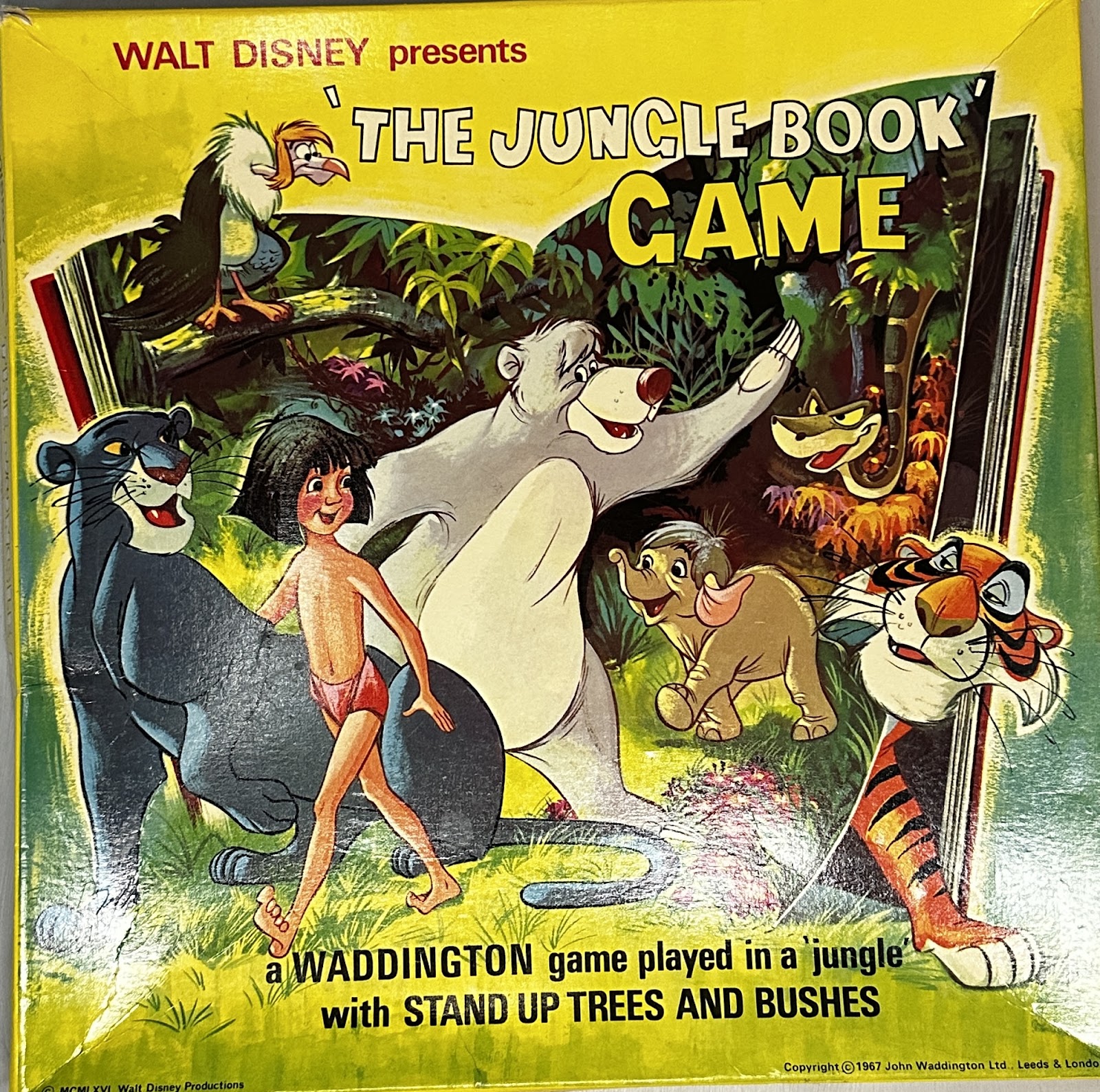
A jungle that stood up off the table
Issued in Britain in 1967 by John Waddington Ltd. of Leeds, “Walt Disney presents ‘THE JUNGLE BOOK’ GAME” did something most board games of its day did not: it built its world upward. Rather than confine play to a flat printed board, the Waddington edition included die-cut, stand-up 3-D scenery—trees and bushes that assembled into a small dimensional jungle for the playing pieces to move through. The presentation leaned on a “pop-up book” style of graphic design, and the lid carried the film’s full cast in bright 1960s lithography: Mowgli the man-cub, Baloo the bear, Bagheera the panther, the python Kaa and the tiger Shere Khan.
The film behind the box
The game arrived alongside one of Disney’s most beloved animated features. The Jungle Book was released in the United States on October 18, 1967, adapted loosely from the Mowgli stories of Rudyard Kipling’s 1894 collection of the same name. Its place in studio history is singular: it was the last animated feature that Walt Disney personally supervised. Walt died on December 15, 1966, while the film was still in production, so its October 1967 premiere came roughly ten months after his death—making the picture, and the merchandise that followed it, a kind of farewell to the era in which Walt himself shepherded every animated feature.
Musically the film is remembered above all for “The Bare Necessities,” the easygoing Baloo number written by Terry Gilkyson, which earned an Academy Award nomination for Best Original Song. The rest of the score came largely from the Sherman Brothers, the songwriting team behind much of Disney’s mid-1960s output. The film’s warm, character-driven comedy—rather than a complex plot—gave licensees like Waddington an easy hook: a handful of instantly recognizable animals in a lush jungle setting, ideal for a colorful family game.
Waddington and Disney in Britain
John Waddington Ltd. was one of the leading British game and printing firms of the twentieth century. Founded in Leeds, the company had moved from theatrical printing into card and board games, and by the post-war decades it was a dominant name on British toy-shop shelves—best known internationally as the U.K. licensee for Monopoly and Cluedo. Its printing heritage mattered: Waddington’s strength in lithography and packaging is what allowed an edition like this one to carry richly colored artwork and elaborate die-cut components.
Disney’s characters reached British children largely through arrangements with home-market manufacturers rather than direct import of American games, and Waddington’s 1967 release sits squarely in that tradition. It belongs to a distinct lineage of British-made Disney games—a tradition that stretches back to the pre-war Chad Valley shooting game tied to Snow White and the Seven Dwarfs and forward to the 1970s, when titles such as Mickey Mouse “All the Fun of the Fair” kept the Disney name in British playrooms. Thematically, too, the game finds company among Disney’s adventure titles—its dense jungle setting echoes the exotic-expedition spirit of Walt Disney’s Adventureland Game, the same Adventureland fascination that Disneyland’s designers built into the now-vanished shops of Adventureland.
As an artifact, the game also captures the look of late-1960s Disney animation at a transitional moment. Its box and components reflect the flat, graphic, xerographic style of the studio’s silver-age cels of the 1950s through 1970s—the same era and aesthetic that produced the film it was made to celebrate. For British families in 1967, it was a chance to send Mowgli and Baloo on an adventure across the living-room floor, just as audiences were meeting them for the first time on screen.


